Who Sold XRP in November? Bayberry Monthly Report, November 2026

Data current to Nov 28, 2026. Participant behavior is measured in XRP wherever possible, because dollar measures fall automatically when price falls.
Summary
XRP is down 24% in November, on pace for its worst November since 2013, but the selling came from leverage, not from holders. Futures open interest fell 29% measured in XRP, while spot holders, US ETFs and Ripple's escrow behaved as they have all year. December brings the XRP Ledger's first native lending, with vaults on Dec 9 and loans on Dec 11.
- -29%: decline in XRP futures open interest in XRP terms, Sep 30 to Nov 28.
- ~98%: share of their XRP that US spot ETFs held through the drawdown.
- 300M XRP: Ripple's net escrow release, unchanged for a fifth straight month.
Price and market structure
XRP traded near $0.94 on Nov 28, down 24.4% for the month so far (TokenPost). November opened near $1.25 (BigGo Finance) and set a low near $0.86 on Nov 21, the lowest price since November 2024 (Hokanews). XRP now trades about 61% below its January peak of $2.41 (edgeX). The final week was a consolidation: daily closes held between $0.925 and $0.949 from Nov 22 to Nov 27 (CoinGlass).
Who sold
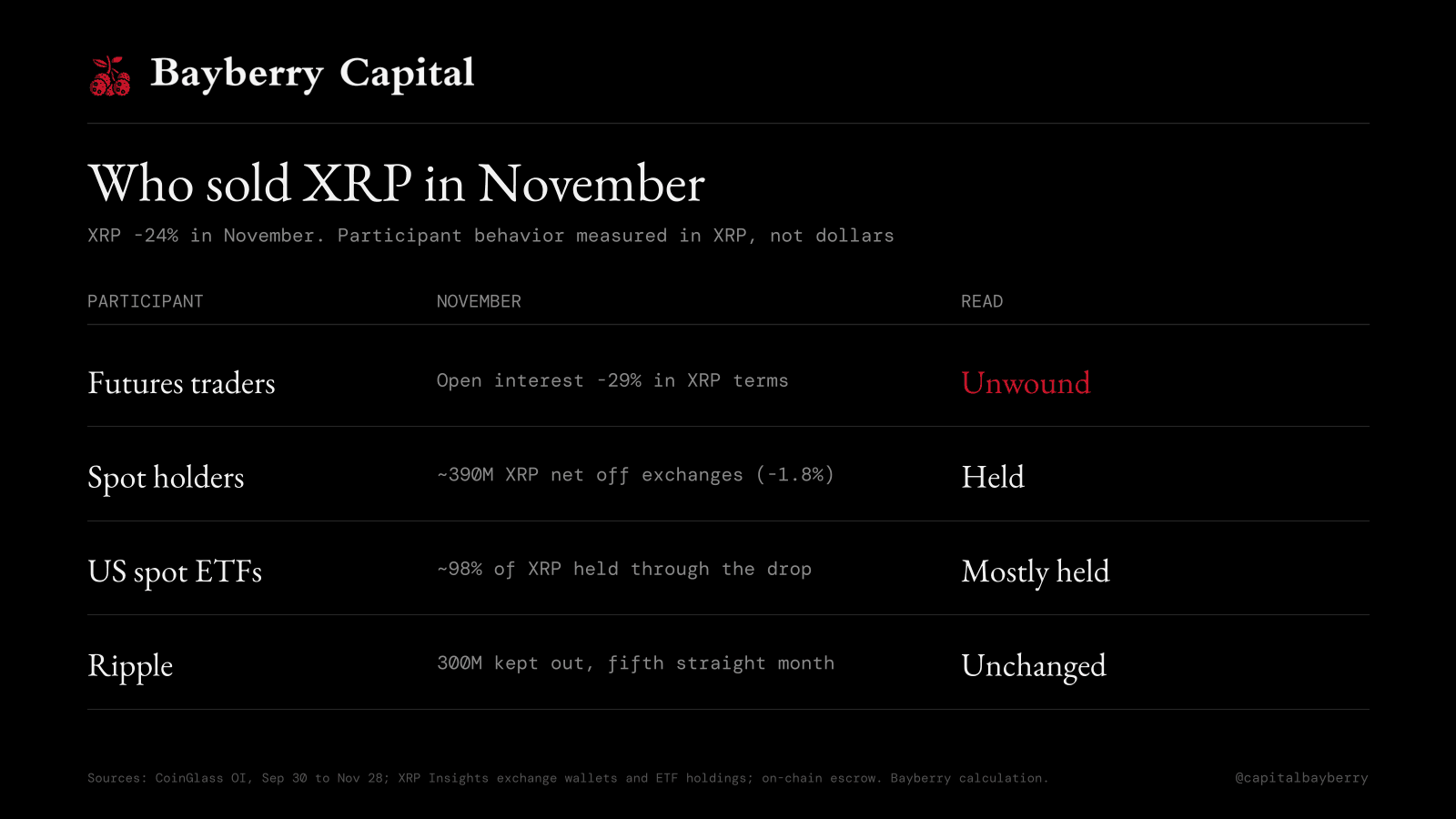
Leveraged traders sold XRP in November; spot holders, funds and the issuer largely did not.
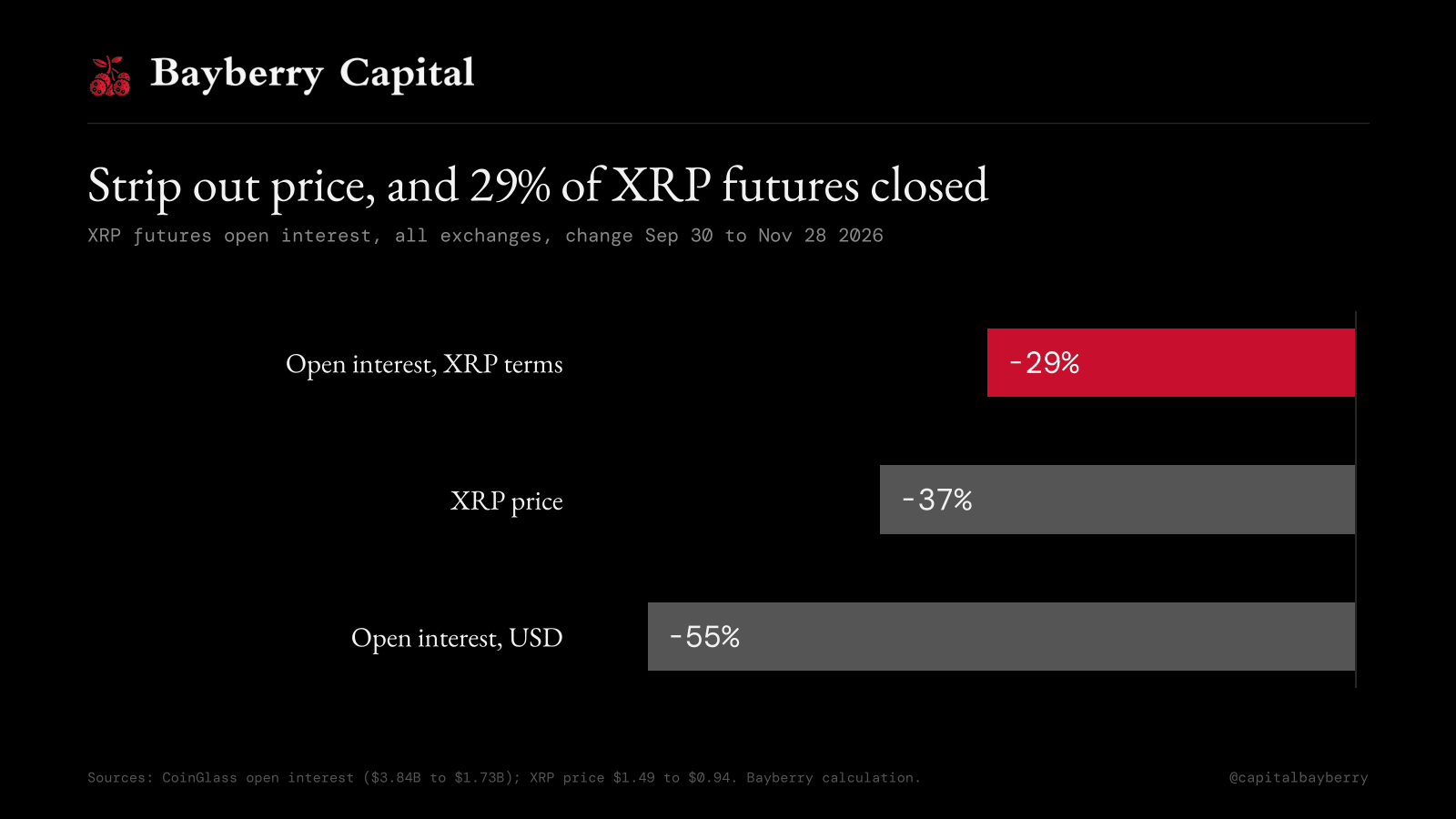
- Futures traders: unwound. Open interest fell 29% in XRP terms (55% in dollars), including the largest long liquidation flush in 13 months.
- Spot holders: held. About 390M XRP net left tracked exchanges, roughly 1.8% of balances.
- US spot ETFs: mostly held. Holdings near 1.18B XRP; the month's net outflow was about 2% of holdings.
- Ripple: unchanged. 300M XRP kept outside escrow, identical to every month since July.
Derivatives: the unwind
Roughly 29% of outstanding XRP futures contracts were closed between Sep 30 and Nov 28, measured in XRP rather than dollars. Dollar open interest fell 55%, from $3.84 billion to $1.73 billion, but over the same period XRP fell 37%, from $1.49 to $0.94. Converting open interest into XRP removes the price effect: outstanding contracts fell from about 2.58 billion XRP to 1.84 billion XRP.
The closures were partly forced. On Nov 14, long liquidations exceeded short liquidations by $44 million across Binance, Bybit and OKX (CoinStats), the largest long liquidation flush in 13 months (The Crypto Basic). On Binance alone, XRP futures open interest fell 42%, from $502 million on Nov 2 to $291 million on Nov 28, a two-year low (TokenPost).
Selling concentrated in futures, not spot. In flow data reported Nov 24, futures showed $69 million of net selling while spot showed $26 million of net buying (The Crypto Basic).
Funding has already normalized. It was negative from mid-November through Nov 25, meaning shorts paid longs (FinanceFeeds). By Nov 28 it was back to +0.0062% per eight hours, about 6.8% annualized (CoinGabbar, citing CoinGlass). Leverage is low, and no longer skewed bearish.
Spot and exchange flows
Spot holders did not sell into the drawdown, though the evidence supports holding rather than aggressive accumulation. Across tracked exchange wallets, XRP balances fell 390.1 million (-1.77%) in the 30 days to Nov 18 (XRP Insights). Gross withdrawals of roughly 5.0 billion XRP were nearly matched by 4.61 billion in deposits over the month (Digital Today, citing CryptoQuant).
The popular Binance figure needs a correction. Its widely cited 160 million XRP decline starts on Nov 9, after Binance restocked about 280 million XRP between Nov 3 and Nov 5 following its Oct 29 security breach (The Crypto Basic). Measured from the pre-restock level of 2.35 billion, Binance's balance of 2.47 billion is up roughly 120 million XRP (BigGo Finance, citing CryptoQuant). Bithumb's balance fell 100 million to 1.75 billion over the month.
Transaction counts lean toward deposits. Binance's seven-day XRP deposit transaction share reached 91.4% on Nov 26, the highest since 2019, and the aggregate share across exchanges rose from 44% to 49% between Oct 27 and Nov 27 (crypto.news). These are counts of transfers, not volumes, and do not establish selling (TokenPost). They are the main spot-side risk to watch in December.
ETFs
US spot XRP ETFs recorded their first monthly net outflow since March, but in XRP terms the funds held roughly 98% of their position. November net outflows stood at $23.79 million as of Nov 28 (TokenPost), ending seven straight months of inflows (FinanceFeeds).
Dollar figures overstate the selling. Combined fund net assets fell below $1 billion on Nov 21, but that decline is mostly price. Holdings measured in XRP moved from 1.19 billion on Nov 12 to 1.18 billion on Nov 25 (XRP Insights). Flows turned positive in the final week: +4.06 million XRP from Nov 23 to 25, after -12.98 million from Nov 16 to 20.
Supply: Ripple's escrow
Ripple released 1 billion XRP on Nov 1 and re-locked 700 million the same evening, in three contracts running to 2029 (CryptoTicker). That leaves 300 million XRP outside escrow, the same net amount as every month since July. Over the past 12 monthly cycles Ripple unlocked 12 billion XRP and re-locked 8.4 billion, a 70% re-lock rate; 31.1 billion XRP remains locked in 99 contracts (CoinCentral).
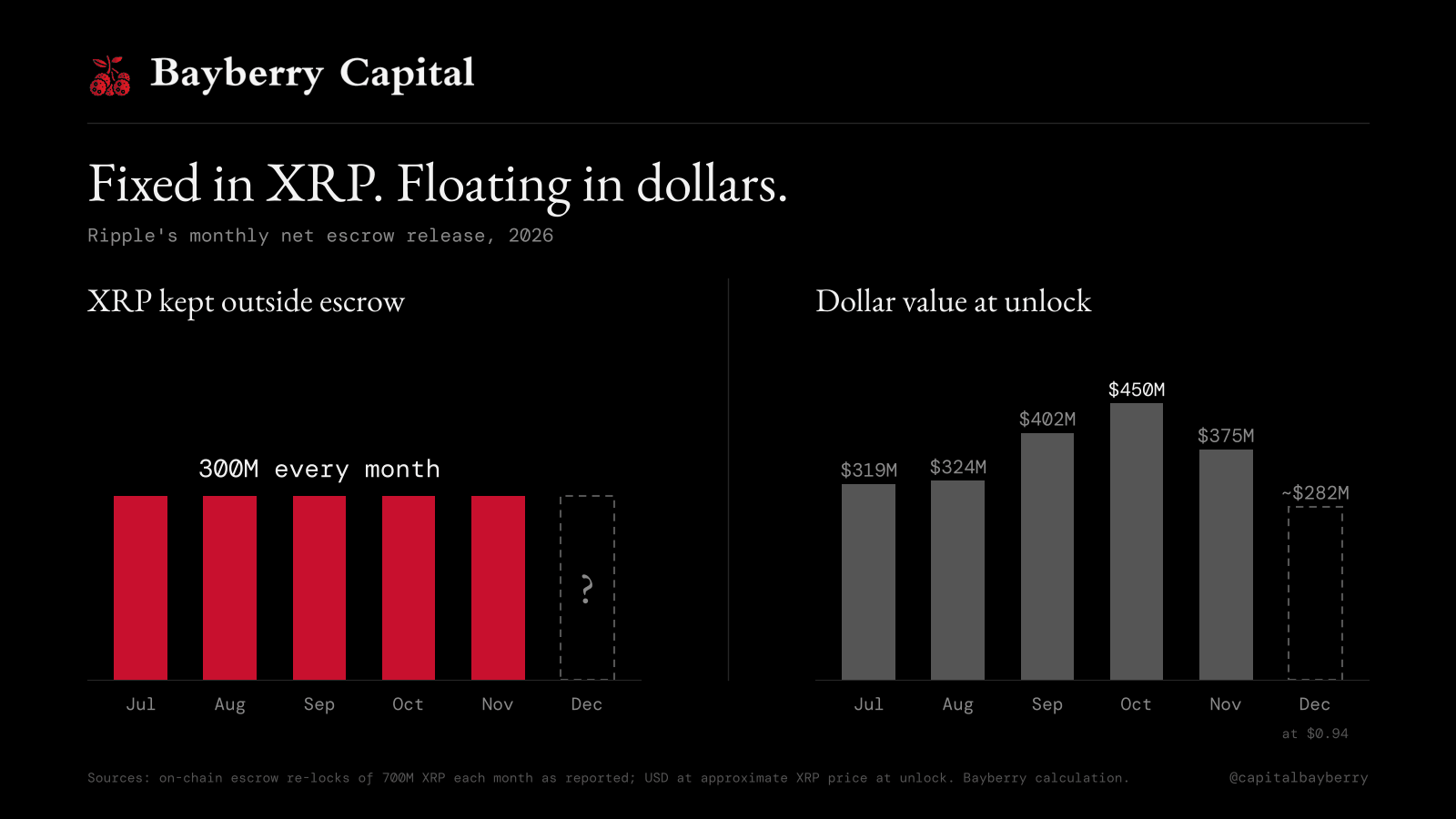
The constant is the XRP amount, not the dollar amount. The release was worth $450 million in October and $375 million in November, and at current prices December's would be worth about $282 million. A distributor targeting dollars would have released more XRP as the price fell. Released XRP is not necessarily sold; Ripple can hold it, use it in operations, or return it to escrow.
December 1 is the test. The same 700 million re-lock would leave about 30.8 billion XRP locked (TalkMarkets). A re-lock below 700 million at sub-$1 prices would be the first change in the pattern since July.
Utility: what the ledger is being used for
Native lending: Dec 9 and Dec 11
SingleAssetVault (XLS-65) began its 14-day countdown on Nov 25, putting activation on Dec 9. LendingProtocol (XLS-66) and its V1_1 patch reached the threshold on Nov 27, targeting Dec 11, provided support stays above 80% (Particle). The Lending Protocol enables fixed-term, uncollateralized loans funded from pooled vault deposits, built into the protocol rather than smart contracts (U.Today). It is the first native lending on the ledger since its 2012 launch.
Depositors carry credit risk. Loans are uncollateralized, so a borrower default can reach vault depositors once the broker's first-loss capital is exhausted (XRP Newsletter). Underwriting quality, not the code, will determine whether these vaults attract capital.
RLUSD: growing, but on Ethereum
RLUSD reached a record $2.87 billion supply on Nov 21 and stood near $2.82 billion on Nov 28 (Crypto Briefing). On Nov 27, Ethereum held about $2.03 billion and the XRP Ledger about $728 million, roughly 26% (Coinpaper, citing XRP Insights). Over the 30 days to Nov 24, supply rose 30% on Ethereum and fell 20% on the XRP Ledger (KuCoin News). Analysts attribute the shift to Ethereum's lending and liquidity venues, which the XRP Ledger has lacked. Native lending is the direct test of that explanation.
Agent payments: real, small, and inconsistently counted
The XRPL AI Hub reported 15,692,399 settled agent payments worth more than $78,000 across 193 merchants by Nov 13 (Gokhshtein). Measured between dashboard snapshots, the daily pace slowed from about 245,000 payments (Sep 8 to Oct 19) to about 46,000 (Oct 19 to Nov 13), while average value per payment rose roughly tenfold. The XRPL case study instead cites a 7-day average of 134,618 per day. The gap is partly definitional: batched sessions settle many paid requests in a single ledger transaction, and trackers count differently (Bitcoin World). We track settled dollar value rather than payment counts.
Thesis
November was a leverage unwind, not a holder exodus, and the forced selling has largely run its course. Futures positions fell 29% in XRP terms while spot holders, ETFs and Ripple behaved as they have all year. Funding has turned positive from a low base, and Binance open interest sits at a two-year low.
The thesis does not call a price bottom. Low leverage removes one source of forced selling; it does not create demand. December's catalysts are utility events, and their effect on price is unproven.
What would change our view
- Tracked exchange balances rise for two consecutive weeks.
- US spot ETF holdings fall below 1.15 billion XRP.
- Ripple re-locks less than 700 million XRP on Dec 1.
- Open interest rebuilds quickly with funding above 0.01% per eight hours, before spot demand shows up.
December calendar
- Dec 1: Escrow release of 1B XRP. A 700M re-lock keeps the pattern for a sixth month.
- Dec 3: SEC Investor Advisory Committee meeting on tokenized stocks (Bitcoin World).
- Dec 9: SingleAssetVault activation.
- Dec 11: LendingProtocol activation; first loans, and whether RLUSD supply on the XRP Ledger stops declining.
- Weekly: ETF holdings and exchange balances, in XRP.
Methodology
Derived figures (open interest in XRP terms, net escrow release in USD, ETF holding share) are Bayberry calculations from the sourced inputs. XRP-terms open interest divides dollar open interest by spot price on each date ($1.49 on Sep 30 per CoinDesk via Xgram; $0.94 on Nov 28 per CoinGlass), so the result is approximate to within a few points. Monthly escrow re-lock reports: July, September, October. Third-party trackers differ in coverage; where they conflict we cite the more conservative figure.
This report is research, not investment advice. Bayberry Capital holds XRP.